Updated 15-Aug-2026

Mammoth vs. Mastodon
Mastodon is software for microblogging. It is a server and comes with a web client (though not required). There are myriad web and native clients for various operating systems. I use the web client in deck multi-column mode (akin to tweetdeck, though less configurable and single account), and Moshidon as my Android web client (works a peach).
What's great about Mastodon
- Can migrate between servers
- Can run own servers
- Various implementations including GoToSocial
- ActivityPub protocol
- Part of the Fediverse
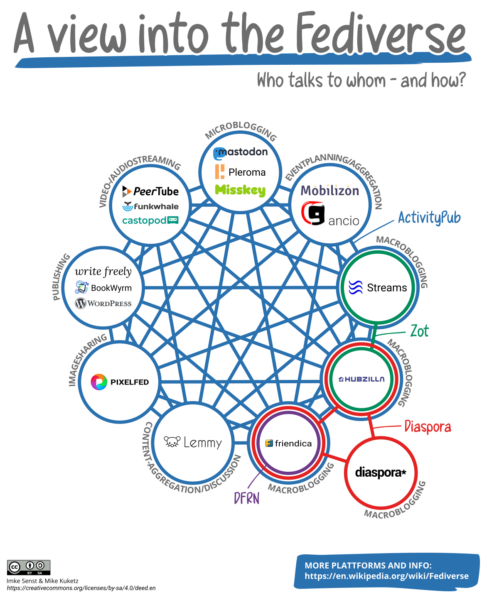
- Can interoperate (somewhat) with Misskey and Pleroma
What's not so great about Mastodon
Programming choices
- Ruby on Rails
- Can't focus on groups functionality
- Limited functionality compared with Misskey and related
Notes on Mastodon use
Fuck Elon Musk. So, Mastodon. I'd created accounts back when it first got started in 2016, so I'm @jeffmcneill@fosstodon.org.
The main thing is to find other people to follow. They are not all on the same server or instance, so it is a matter of tracking them down. At some point more automated following utilities should be available. Because of this mass exodus from Twitter (though it remains to be seen how much mass is exodusing), people are creating files of their colleagues and their Mastodon handles (@username@instance). This is true for whatever part of the fediverse one wants to join. Of course these can all be a private archive of thoughts and media, if desired. But federation is the main concept animating them all.
Note that I've largely avoided Pixelfed which is just Mastodon with a different layout. Namely this is because the developer basically ignores all merge requests and doesn't really respond to requests for information and discussion on his own Github issues board.
Instances to select from
There are quite a few instances of Mastodon and other Fediverse projects. The differences between them can be based on their various rules (posting requirements, which other instances are blocked), a given niche community (if any), and the stability (uptime) and speed (latency) of the instance, which version of the software is running, etc. Many instances have one or two users, and because of federation, can still talk with most other instances and users on them.
The only thing that matters in terms of a given server is the quality of the local feed. However with a smarter client one can follow instance/explore as a quasi-hashtag (Moshidon supports adding additional server timelines). One example use case is that I like many of the hachyderm.io/explore posts but the admins to me are annoying and clue-resistant, so I'm not on their server but can still view the local timeline. A handy feature.
For Mastodon, likes don't appear in timelines, so the boost is what one wants to do. There is no quote tweet, just simply engage with the tweet and/or boost it. That may change in future updates to the software.