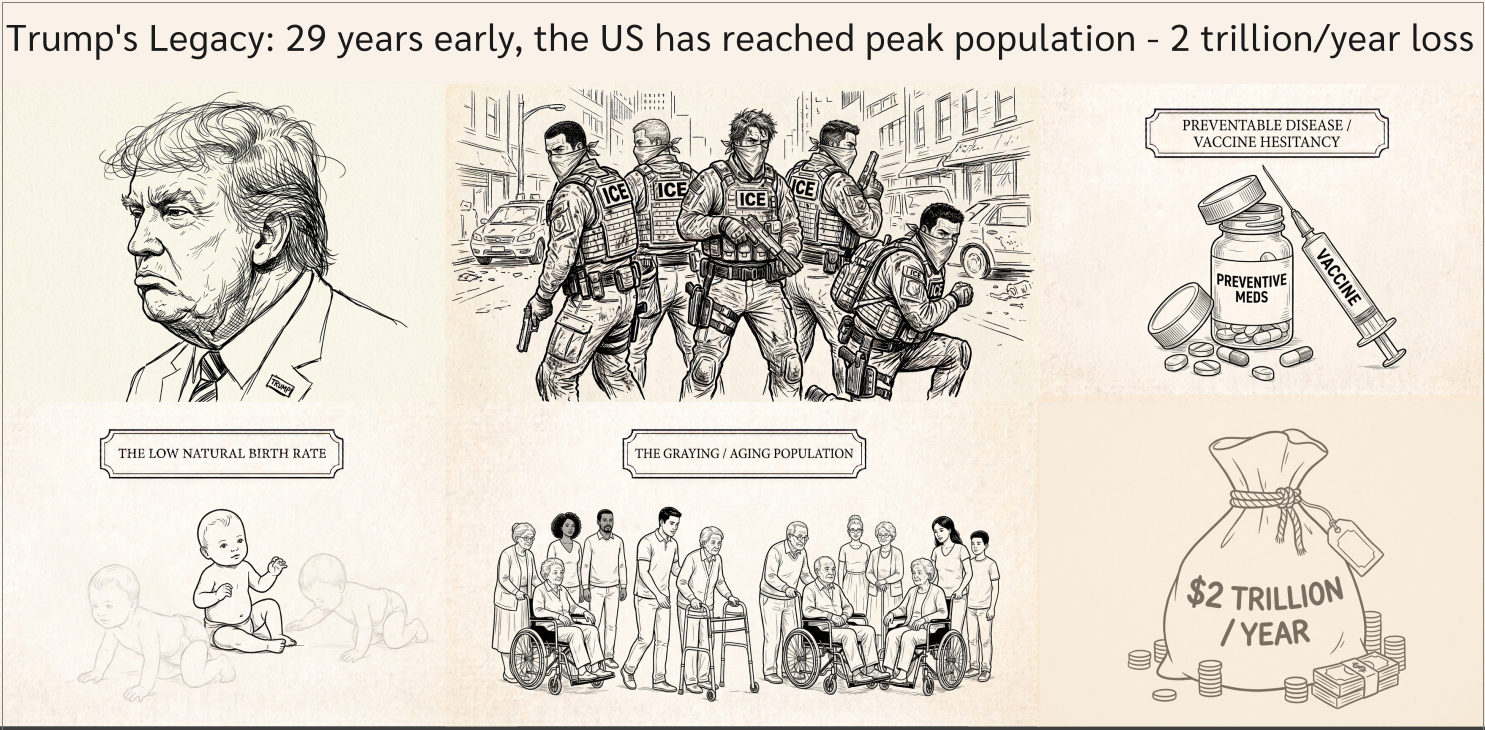
How Trump Erased 29 Years of Growth
America is undergoing a silent structural shift - a rapid transition into demographic stagnation. For generations, the United States avoided the economic sclerosis and population collapse haunting Western Europe and East Asia. While nations like Japan and Italy fought shrinking workforces, the U.S. expanded steadily, anchored by moderate fertility and a steady influx of young, dynamic international migration.
That vital buffer has been eliminated. Driven by a perfect storm of structural aging, lingering post-pandemic mortality trends, aggressive anti-immigration enforcement, and institutional skepticism toward public health, the United States is rapidly approaching an abrupt demographic wall.
The nation is crossing the threshold from population growth into an unprecedented structural plateau. By intentionally shutting down net migration while elevating preventable baseline mortality, federal policy has effectively pulled the date of peak U.S. population forward by nearly 30 years - from the mid-2050s straight into the late 2020s.
Unpreventable Aging and Preventable Disease
To understand the speed of this slowdown, one must look at the natural balance sheet of the nation: annual births minus annual deaths.
According to data from the CDC National Vital Statistics System, U.S. births have flattened out at approximately 3.6 million annually. The total fertility rate sits at roughly 1.55 children per woman-well below the replacement threshold of 2.1.
Simultaneously, the underlying death baseline has permanently shifted upward. Driven by the aging of the 73-million-strong Baby Boomer generation alongside post-viral cardiovascular complications, annual U.S. deaths now average between 3.07 million and 3.09 million per year.
U.S. NATURAL POPULATION CHANGE (Births - Deaths)
Pre-Pandemic (2015): ~3.98M Births - ~2.71M Deaths ─► +1,265,000 / year
Current (2025–2026): ~3.60M Births - ~3.09M Deaths ─► +510,000 / year
In a decade, the natural growth engine of the United States contracted by roughly 60%. With the natural birth-death surplus narrowing to barely 500,000 people annually, net international migration was the single remaining pillar sustaining American population growth.
Institutionalizing Skepticism: The Public Health Deficit
Compounding this natural narrowing is a deliberate dismantling of public health protections. Under Department of Health and Human Services (HHS) Secretary Robert F. Kennedy Jr., federal health policy has shifted toward institutionalized vaccine skepticism.
By withdrawing CDC vaccine recommendations for pregnant women, altering immunization guidance, and redirecting agency resources away from disease prevention and toward investigating vaccine injuries, federal policy has actively eroded public trust in routine immunization.
PUBLIC HEALTH POLICY SHIFT & MORTALITY IMPACT
Policy Changes ─► Ongoing Outbreak Burden ─► Elevated Annual Deaths
(Resurgent ~90,000 Post-COVID Deaths/Yr)
The epidemiological result is a sustained mortality drag:
- The Ongoing Viral Toll: Direct COVID-19 deaths combined with unrecorded cases and post-viral cardiovascular events (heart attacks and strokes triggered by prior infection) continue to claim approximately 90,000 lives annually.
- Resurgent Outbreaks: Eroding coverage for routine MMR, DTaP, and respiratory vaccines lowers herd immunity across communities, exposing children, the elderly, and immunocompromised adults to elevated disease mortality.
- Perpetuating Elevated Baseline: Instead of returning national mortality toward pre-pandemic levels (~2.7M), institutionalized health skepticism ensures that preventable infectious diseases add thousands of avoidable deaths to the national tally every single year.
Immigration Population Growth Sabotage
Instead of managing this demographic narrowing and elevated mortality, current Trump / Republican policy has destroyed the growth of 500,000 additional population by causing a net loss of 500,000 residents.
Through strict border enforcement, heightened administrative hurdles, accelerated deportations (of any and all migrants caught up in the wave of ICE actions), and voluntary departures, net international migration plummeted from its post-pandemic recovery levels to net-negative. When a country with a narrowing natural increase of +500,000 experiences a net migration outflow of equal or greater magnitude, the national growth rate hits 0.0%.
The consequences of this math are stark:
- The Original Horizon: Benchmark models from the Congressional Budget Office (CBO) projected that under moderate immigration flows (~1 million net entries per year), the U.S. population would peak at approximately 364 million people in 2056.
- The Accelerated Reality: Under current enforcement trends and elevated mortality, that timeline collapses. Peak U.S. population will occur between 2026 and 2028, capping out at roughly 342.5 million to 343 million people.
A loss of 21 million people from 2027-2056
PEAK POPULATION SCENARIOS
364.0M ─► Projected 2056 Peak (Moderate Inflow & Standard Public Health) 343.0M ─► Accelerated 2026-2028 Peak (Negative Net Inflow & Elev. Mortality) 21.0M ─► Missing National Capacity ("The Erased Growth")
The $2 Trillion yearly loss
Pulling peak population forward by three decades does not merely alter demographic charts-it permanently constrains American economic output.
A 21-million-person deficit in projected national capacity represents a structural loss of approximately 13 million working-age adults. Translating that labor deficit into macroeconomic terms yields significant long-term consequences:
- Lost Gross Domestic Product: At average U.S. worker output metrics, a permanent reduction of 13.5 million workers removes $2.0 trillion to $2.8 trillion annually in GDP-a permanent 7% to 9% drop in total national economic capacity.
- Fiscal Entitlement Strain: Programs like Social Security and Medicare operate on pay-as-you-go tax revenue. Removing millions of young, active workers while 73 million Baby Boomers retire pushes the worker-to-retiree ratio down from 2.7 toward 1.9 workers per retiree, threatening public safety nets.
- Chronic Labor Deficits: Agriculture, construction, healthcare, and technology sectors face structural labor shortages that drive up consumer costs and slow infrastructure investment.
Thoughtless policies, damning results, Trump legacy
Countries across the globe are grappling with demographic decline. Yet while nations like Japan and Germany aggressively implement policy interventions, automation initiatives, and targeted worker programs to blunt the impact of aging populations, the United States is actively choosing policies that accelerate its own demographic cliff.
Closing border entries, encouraging worker outflows, and institutionalizing health policies that perpetuate thousands of preventable deaths every year does not create economic security - it enforces national contraction. If current federal policies persist, the era of American expansion will not fade gradually in the mid-21st century - it will end before this decade is out, indeed if it has not already. The costs are unconscionable.
Granted, Trump is not necessarily responsible for the Low Birth Rate (though there is something to be said for impoverishing the working classes), nor the aging population, but Immigration reductions, vaccine hesitancy, and Emigration are all the results of his disasterous policies and behavior. That's 45% or basically $900 Million/year.
| Cause | Estimated Share (%) | Annual GDP Impact | Key Metric |
|---|---|---|---|
| Low Birth Rate | 35% | $700 Billion | TFR at ~1.53–1.58 vs 2.1 replacement |
| Immigration Reductions | 30% | $600 Billion | Net immigration down >50% |
| Aging Population | 20% | $400 Billion | ~11,000 retirements/day; 2.2:1 worker ratio |
| Vaccine Hesitancy / Health | 10% | $200 Billion | ~1M+ workforce exits / Long COVID costs |
| Emigration / Outflows | 5% | $100 Billion | ~200k annual emigrants + brain drain |
| Total Combined Impact | 100% | $2.0 Trillion | Annual GDP deficit |