Updated 22-Oct-2026
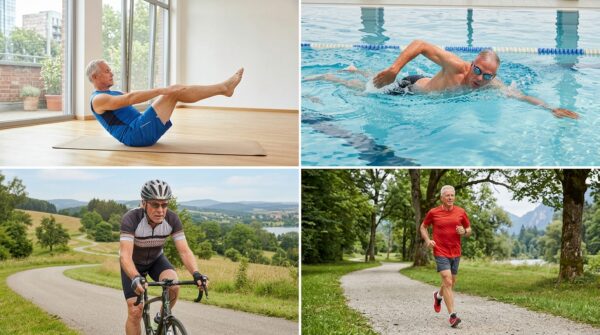
By that I mean the 60-year-old is that old and the exercise plan is not, but is meant for that old dude.
Activity Breakdown & Durations
- Floor Pilates: 30 to 45 minutes (Active recovery / core focus on Monday).
- Jogging / Run-Walk: 30 to 45 minutes (Weight-bearing bone-density cardio).
- Swimming: 45 to 60 minutes (Low-impact full-body cardio & joint decompression).
- Bicycling: 60 to 75 minutes (Non-impact leg endurance & quad strength).
Your Fixed 7-Day Weekly Schedule
| Day | Activity | Duration | Workout Focus |
|---|---|---|---|
| Monday | Floor Pilates | 30–45 min | Core strength, spine mobility & stretching |
| Tuesday | Jogging | 30–45 min | Weight-bearing cardio & bone health |
| Wednesday | Swimming | 45–60 min | Low-impact cardio & shoulder mobility |
| Thursday | Bicycling | 60–75 min | Quad/glute strength & leg endurance |
| Friday | Jogging | 30–45 min | Weight-bearing cardio & leg power |
| Saturday | Swimming | 45–60 min | Low-impact cardio & joint decompression |
| Sunday | Bicycling | 60–75 min | Long steady endurance ride |
Essential Tips to Prevent Tendon and Joint Strain When Doing Physical Activity 7 Days a Week Over 60
Exercising seven days a week over age 60 keeps your cardiovascular health high and your momentum strong. However, tendons and joint cartilage take longer to adapt and repair than muscle tissue. Without dedicated rest days, preventing chronic strain - such as Achilles tendinitis, runner’s knee, or rotator cuff irritation - requires a deliberate strategy focused on load management and active tissue care.
Here are the essential guidelines to keep your joints and tendons healthy on a 7-day routine:
1. Manage Mechanical Load & Impact
- Use the Run-Walk Method: Jogging provides crucial bone-density benefits, but the foot-strike impact is where tendon strain accumulates. Structuring your run days with interval walks (e.g., 3–4 minutes jogging, 1 minute walking) cuts peak repetitive stress on your Achilles tendons and knees by 20–30% without reducing aerobic cardiovascular benefits.
- Vary Your Swimming Strokes: Swimming on Wednesdays and Saturdays provides great low-impact cardio, but repeating the exact same freestyle stroke can irritate the rotator cuff tendons. Alternate between freestyle, backstroke, and breaststroke, or spend 10 minutes doing simple water walking to vary shoulder mechanics.
- Keep Pedaling Cadence High on Bike Days: On Thursdays and Sundays, avoid pushing heavy gears at a slow, grinding pace (below 60 RPM), which places heavy compressive force on the kneecap (patellofemoral joint). Aim for a lighter gear at a smooth cadence of 75 to 85 RPM to transfer the work to your heart and lungs rather than your knee joints.
2. Dynamic Warm-Ups & Post-Workout Care
- Never Start Cold: Tendons are like rubber bands, they become stiffer with age and tear easily when forced to stretch or absorb impact cold. Spend 5 minutes before every session doing dynamic mobility (arm circles, leg swings, gentle torso twists, ankle rolls) before stepping into your jog, swim, or ride.
- Prioritize Calf and Hamstring Flexibility: Tight calf muscles are the primary cause of Achilles tendinitis and plantar fasciitis in runners over 60. Spend 3 to 5 minutes after your Tuesday/Friday jogs stretching your calves against a wall or curb.
- Use Monday’s Pilates for Targeted Glute Activation: Knee pain often stems from weak hip and glute stabilizers. Ensure your Monday Pilates session emphasizes bridge poses, clamshells, and bird-dogs to keep your glutes firing properly during your midweek runs and rides.
3. Gear & Environmental Control
- Replace Running Shoes Every 300–400 Miles: Cushioning breaks down internally long before the outer tread looks worn. Old shoes lose their impact-absorption capacity, transferring shock straight into your ankles, knees, and lower spine.
- Bike Setup (Professional Fit): If your bike saddle is even half an inch too low, your knees flex too deeply under load, causing anterior knee pain. If it is too high, your hips rock and strain the hamstring tendons. Ensure your saddle height allows a slight 25–30 degree bend in the knee at the bottom of the pedal stroke.
- Choose Softer Running Surfaces: Whenever possible, jog on smooth dirt paths, gravel trails, asphalt, or rubberized tracks rather than hard concrete sidewalks. Concrete delivers up to 10 times more shock impact to joint cartilage.
4. Recognize the Warning Signs
When exercising daily, it is critical to distinguish between harmless muscle soreness and tendon/joint strain:
| Signal | What It Means | Action Required |
|---|---|---|
| Dull muscle tightness that warms up and disappears | Normal muscular adaptation | Continue activity as planned. |
| Morning stiffness in a tendon (e.g., Achilles, patellar) that hurts for the first 5 minutes of moving | Early-stage tendinopathy | Reduce intensity by 30–50% on that activity; do not push through. |
| Sharp or localized joint pain during movement | Active joint inflammation or cartilage distress | Stop the specific movement immediately; swap for extra swimming or light walking. |
5. Hydration & Tendon Nutrition
- Hydrate for Cartilage Health: Joint cartilage is roughly 70–80% water. Dehydration reduces the fluid cushion inside your joint capsules, increasing friction and wear. Drink water steadily throughout the day, not just during your workout.
- Protein Intake: Consuming adequate protein (roughly 1.0–1.2 grams per kilogram of body weight daily) ensures your body has the amino acid building blocks required to repair connective tissue between daily sessions.
6. Supplements
- Vitamin B12
- Vitamin D3
- Undenatured Type II Collagen
- Creatine Monohydrate
- Soy Protein Isolate
- Tart Cherry
Even with the protein, I've gotten this down to 35 baht/day (about $1 USD):

Note that Gemini helped with this, but all info is verified. Gemini also clued me in to Tart Cherry, though I've known about and used the other stuff for a while now.