Updated 26-Aug-2026
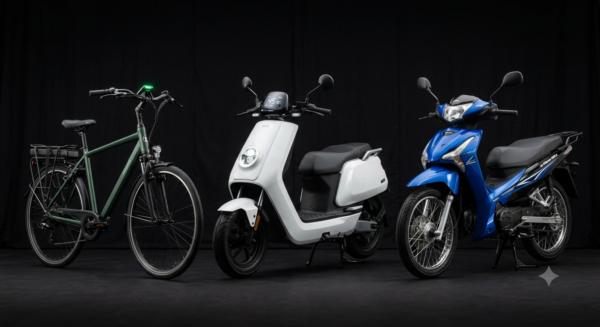
Ebikes - E-Bikes are many and varied. This article attempts to discuss them in terms of technology, use case, and laws pertaining to them. The main point is that there are two kinds of ebikes, those treated as bicycles, and those treated as motorbikes, based mainly on the technology (motor size, maximum speed, and in some cases how the motor-assist provides assistive power (percentage of assistance).
There are also of course many different styles of ebikes from high performance sleek bicycle trim to pokey three-wheel golf carts, to slim mopeds with a cute look. To make things clearer, I'd like to propose three categories:
- ebikes (<25kph / 250watt max), treated as bicycles for licensing, registration purposes
- those that look like bicycles
- those that look like mopeds
- utility emotorbikes (60-80kph), treated as motorbikes, cheaper, but decent utility bikes around town (limited highway use)
- those that look like standard motorbikes
- Note that there are many emotorbikes between this utility class and ebikes below it, but those make no sense if they are to be licensed as a motorcycle, or cannot even do that due to not meeting legal requirements (see Thailand laws below).
- standard emotorbikes (100-120kph)
- treated as motorbikes, not cheaper,
- effectively the same as a Honda Wave 125i or Honda PCX 150, and their cheaper cousins, as well as big bike sizes
- Ultra Violette and Avore are great upcoming Indian models that are fully 125-replacement worthy.
- high performance bikes
- This is a forth class of emotorbike, basically sport models
There is nothing to prevent the prices of these vehicles from coming down other than scaling up manufacturing (and possibly battery-swapping infrastructure, as the Vietnamese Vinfast has done). Technically, ebikes cost less to manufacture (simpler, less expensive parts), and less to ride (electricity vs. petroleum costs). Battery prices will continue to decline, as should electricity prices. The trends are all in the right direction.
- 888bike.net Thai suppliers of many varied ebikes.
Ebike conversion and select vendors
- Bafang mid-motor conversion kit (video)
- Electrom
- Grin Technologies
- Cargo bikes Thai custom manufacturer
Ebike laws by country
Laws are many and varied by jurisdiction. Many laws are country-wide, but in places like the United States, there are state laws, which are also many and varied. That said, there are a few guidelines overall (though compliance in each country usually requires certification of the vehicle and/or inspection. Below are listed the regulations in Thailand, Japan, and Spain.
Thailand ebike laws
Many blogs write that there aren't any real laws on the books in this area. The idea is if it looks like a motorbike or performs like a motorbike, it should be licensed as a motorbike.
This is complete nonsense. There are such laws in Thailand, though the are incompletely enforced, and many ebikes do not comply with the law.
That said, there are many low speed ebikes without much in the way of pedals that are puttering around on the local village roads.
Thailand E-bike and E-motorcycles
E-bike
- Electric motor not exceeding 250 watts
- Maximum speed not exceeding 25 kph
- Does not require motorcycle license, or registration
- Ride according to bicycle rules
- Note that besides the amount of power on ramp up, this is similar to Japan
Note that there is coming enforcement for use of bicycle helmets.
E-motorcycle
- Electric motor from 250 watts and up.
- Can achieve maximum speed of not less than 45 kph.
- Requires motorcycle speed level braking system.
- Requires specific angles and levels of brightness for headlights, taillights, and turn signals.
- Requires horn, rear-view mirror, spedometer, and stable license mounting point.
Note that motorcycle helmets are required for E-motorcycles.
Note also that electric vehicles that are in the grey area (either with more power but not a higher speed, or with 250 watts but can go faster - unlikely) are neither a bicycle nor a registerable motorbike, therefore would be illegal to ride on roads.
Enforcement of Thai laws
- Thai police began enforcing unregistered vehicles by deducting points against driver's licenses, as well as fines.
- It is illegal to use unregistered vehicles on public roads.
- Driving without a motorcycle license is illegal.
- Driving a motorcycle as well as a bicycle on the sidewalk is illegal.
Japan ebike laws
In Japan, the official term for a legal e-bike is 電動アシスト自転車 (denki asisto jitensha), electrically assisted bicycle.
- The motor must only engage while the rider is actively pedaling. A bike that moves under motor power alone, without the rider pedaling, is not a bicycle under Japanese law. It is classified as a moped or motor vehicle, which requires a license, registration, insurance, and a number plate.
- The motor assist must taper gradually as speed increases. Below 10 km/h, the motor can provide up to twice the force of your pedaling effort. Above 10 km/h, the ratio decreases gradually until it reaches zero at 24 km/h. This graduated system is specific to Japan and differs from the flat output limits used in Europe.
- Any e-bike that meets these three conditions can be ridden without a license and needs no registration. It is treated exactly like a standard bicycle for all road purposes, including the new Blue Ticket fines.
- Look for the TS mark (型式認定) on the frame. This is Japan's official type-certification mark confirming the bike meets the Road Traffic Act standards. Reputable manufacturers and rental shops use certified models. No TS mark means no certainty about compliance.
- As a bicycle, can be fined for all the blue ticket violations, including:
- Both ears covered with earphones (one ear and bone-conducting are allowed).
- Riding against traffic.
- Using phone while riding.
- Speed through shared spaces (those with pedestrians)
- Note that all bicycles must be registered at the local shiaksho/koban, but no number plates required.
Spain ebike laws
Pedal-assisted electric bicycle (EPAC) vs. moped/motorcycle.
- Maximum power 250 watts
- Maximum assist speed 25 km/h
- Assistance only while pedaling
- EN 15194 certification guarantees these
- EPAC treated as bicycles for all laws
Ebike safety in general
- Small wheeled ebikes (8-12") are much more dangerous in rough road conditions. This applies also to folding bicycles.
- For the smaller variety, bicycle helmets are required in many places, and for the faster motorbike speeds (above 25kph) motorbike helmets are required.